Spoke tension too high and/or rim manufacturer QC too low.
Team-_-dank on
It’s cracked and broken, what does a temperature controlled room have to do with it?
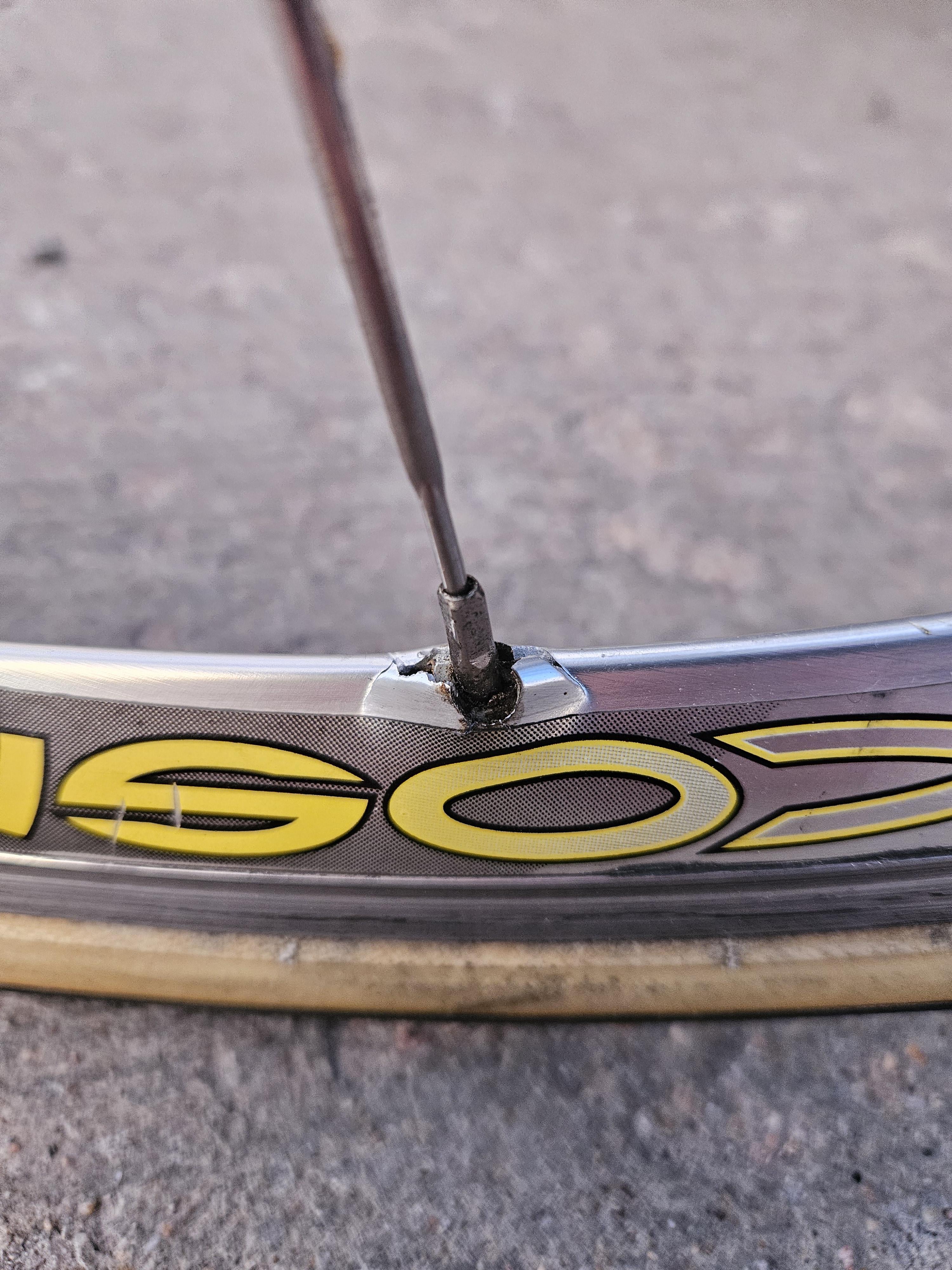
Either an impact, over tensioned, and/or manufacture defect.
How old is it?
Rohath on
My best speculation is the metal has fatigued with age (mavic cosmic wheel so 90s wheel?)and that combined with being under tension for 20+ years just led them to give way. Whees tend to crack at the spoke holes so could has been the most minuscule crack there for years that has just slowly grown to how we sit it now
PineappleLunchables on
Looks like galvanic corrosion between the carbon fiber (is it a CF rim?) and aluminium spoke. This can happen even due to exposure to oxygen in the atmosphere. I think this can occur when the composite has a pretty high carbon content because carbon is more ‘noble’ (ie further to the left on the periodic table than aluminium in the spoke or brass (copper/zinc) in the nipple. Note that this can also occur if the rim is aluminum and the nibble is brass. It’s possible that no or not enough carbon paste or was used at the spoke holes during wheel assembly. Anywhoo, I think your rim is done.
kriger33 on
Aluminum has a fatigue life regardless of oxidation/corrosion (those do exasperate it though).
“While not every engineer uses the same terminology, for the purposes of this article, a material’s fatigue limit or endurance limit is the highest stress that the material can withstand for an infinite number of cycles without breaking. When it comes to metals used in bicycle frames, only steel and titanium have a fatigue limit. This means that if the stresses applied are below a certain percentage of a steel or titanium tube’s ultimate strength (or “tensile strength” — the stress required to break it with a single application of that stress) — the percentage at the fatigue or endurance limit, then no number of stress cycles will result in failure.”
[Aluminum does not have a distinct fatigue or endurance limit, so its S-N graph curves down from the upper left to the right and continues to curve down lower and lower toward the lower right corner of the graph. This illustrates that it will eventually fail even from low stress applications, given enough of them.](https://velo.outsideonline.com/road/road-racing/technical-faq-aluminum-frame-crankarm-fatigue/)
geeves_007 on
I dunno, maybe because this wheel is over 30 years old?
Toni_Carbonara on
That wheel is a relic it’s not wine it won’t age nicely in a climate controlled room.
spectrumero on
Presumably you’ve been riding it – it will be wear and tear from riding. Aluminium will eventually fatigue and crack. It’s why aluminium aircraft (at least, anything built since the regulations changed in the 70s) have life limits on structural components.
577564842 on
Not everything can be attributed to the climate change.
drivingistheproblem on
the climate control was set to freeze/thaw?
behavedave on
I’m no Hercule Poirot but the ‘O’ looks like it has been pushed down and the cracking on top looks like it has been pulled out. It does look more like trauma more than an over tightened spoke grouped with fatigue.
Brilliant-Witness247 on
That wheel looks like it could be 20+ years old. All material fatigues
beachbum818 on
Impact my friend, 0 to do with climate. you probably road on it a few times before you noticed it.

13 Comments
Spoke tension too high and/or rim manufacturer QC too low.
It’s cracked and broken, what does a temperature controlled room have to do with it?
Either an impact, over tensioned, and/or manufacture defect.
How old is it?
My best speculation is the metal has fatigued with age (mavic cosmic wheel so 90s wheel?)and that combined with being under tension for 20+ years just led them to give way. Whees tend to crack at the spoke holes so could has been the most minuscule crack there for years that has just slowly grown to how we sit it now
Looks like galvanic corrosion between the carbon fiber (is it a CF rim?) and aluminium spoke. This can happen even due to exposure to oxygen in the atmosphere. I think this can occur when the composite has a pretty high carbon content because carbon is more ‘noble’ (ie further to the left on the periodic table than aluminium in the spoke or brass (copper/zinc) in the nipple. Note that this can also occur if the rim is aluminum and the nibble is brass. It’s possible that no or not enough carbon paste or was used at the spoke holes during wheel assembly. Anywhoo, I think your rim is done.
Aluminum has a fatigue life regardless of oxidation/corrosion (those do exasperate it though).
[Fatigue Limit ](https://en.m.wikipedia.org/wiki/Fatigue_limit)
“While not every engineer uses the same terminology, for the purposes of this article, a material’s fatigue limit or endurance limit is the highest stress that the material can withstand for an infinite number of cycles without breaking. When it comes to metals used in bicycle frames, only steel and titanium have a fatigue limit. This means that if the stresses applied are below a certain percentage of a steel or titanium tube’s ultimate strength (or “tensile strength” — the stress required to break it with a single application of that stress) — the percentage at the fatigue or endurance limit, then no number of stress cycles will result in failure.”
[Aluminum does not have a distinct fatigue or endurance limit, so its S-N graph curves down from the upper left to the right and continues to curve down lower and lower toward the lower right corner of the graph. This illustrates that it will eventually fail even from low stress applications, given enough of them.](https://velo.outsideonline.com/road/road-racing/technical-faq-aluminum-frame-crankarm-fatigue/)
I dunno, maybe because this wheel is over 30 years old?
That wheel is a relic it’s not wine it won’t age nicely in a climate controlled room.
Presumably you’ve been riding it – it will be wear and tear from riding. Aluminium will eventually fatigue and crack. It’s why aluminium aircraft (at least, anything built since the regulations changed in the 70s) have life limits on structural components.
Not everything can be attributed to the climate change.
the climate control was set to freeze/thaw?
I’m no Hercule Poirot but the ‘O’ looks like it has been pushed down and the cracking on top looks like it has been pulled out. It does look more like trauma more than an over tightened spoke grouped with fatigue.
That wheel looks like it could be 20+ years old. All material fatigues
Impact my friend, 0 to do with climate. you probably road on it a few times before you noticed it.