
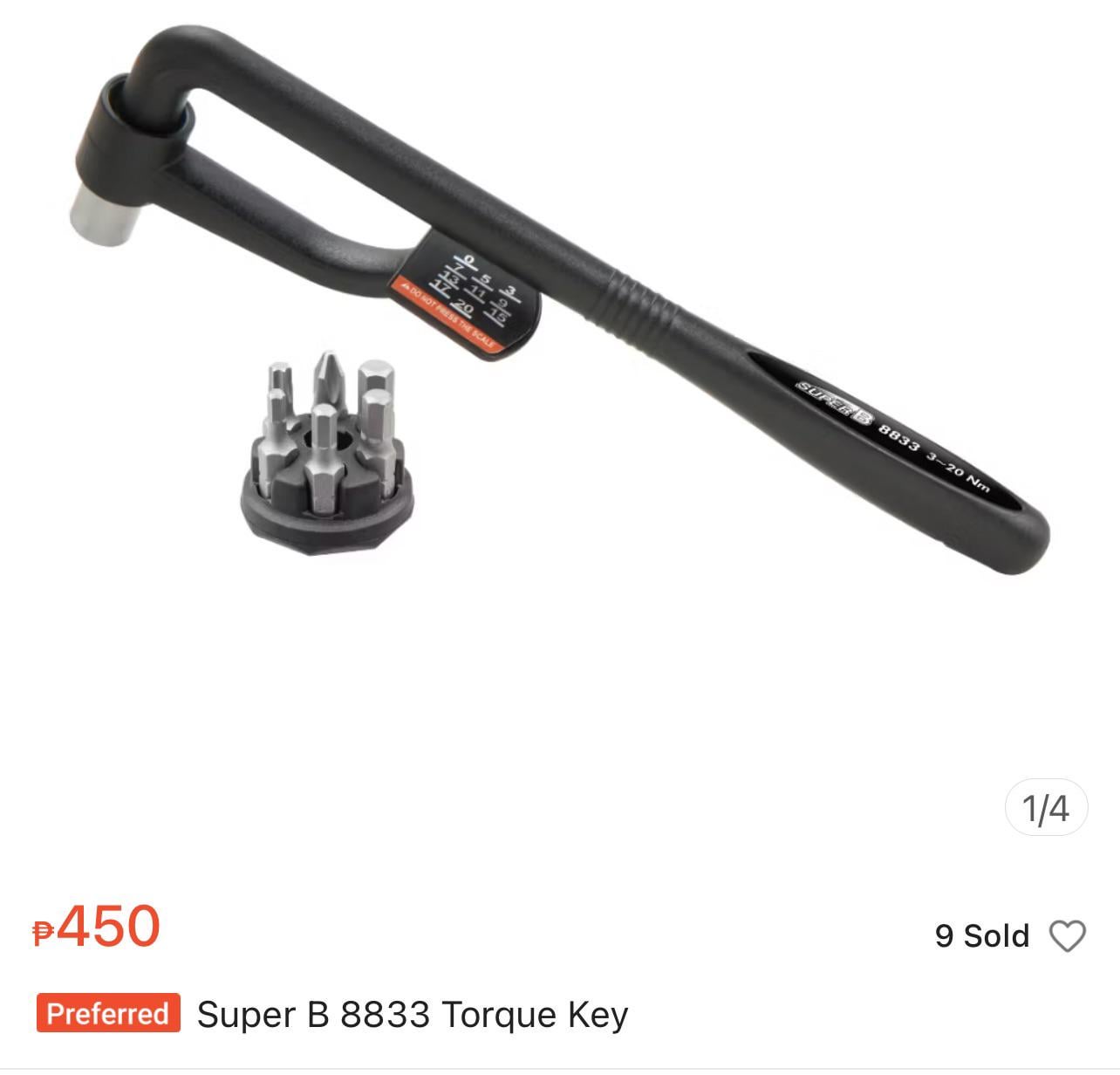
So I recently bought this product and so far Ive been using it on my Surly, but I recently bought a new carbon bike and now Im wondering if it would be accurate and safe enough to use on it, with the Surly Im not too worried since it’s made of chromoly steel.
by AfternoonCareless
14 Comments
No. They will get you I. The right ball park but that’s it. They are ok for a basic bike but I would not recommend them for carbon parts.
Will be fine unless there’s a manufacturing/QC error, witch is not entirely unlikely and can be difficult to find out.
I hope so because I just used one for my carbon bars.
I prefer these beam style wrenches in general, they don’t need calibration (or if they do it’s just a matter of bending back to zero).
They work by know how much force is needdd to deflect the metal. It’s very old school and simple. Just need to make sure you read the gauge straight on.
Yes. It’s fine.
“Carbon” isn’t magic. Manufacturers tend to use it in lighter, leaner designs where they start having to specify fastener torque instead of the oldfashioned “*Do it up really tight*”, but I haven’t yet seen any manufacturer that requires really narrow torque tolerances for bikes sold to the public, and I would be both surprised and grateful if the folk who pretend they need special high-precision torque wrenches for their seatpost could provide an actual example.
The oldfashioned “manual” torque wrenches have another advantage for home users – no battery needed, therefore no risk that you’ll reach for a dusty tool in your toolbox and discover that the battery went flat months ago. (Same reason I use an oldfashioned micrometer). If you were a Serious Mechanic using the tool ten times a day, then digital is probably worthwhile and you’ll have a spare battery lying around somewhere… 🙂
Beam style are good . Used all over industrial style work .
Wether this one is good . Id error on spending a tiny bit more. Looks to be very low end .
The real factor that matters in terms of not breaking parts is bolt tension. Torque is a **very** crude method to achieve a specific bolt tension. It’s crude because bolt finish, surface coating, tolerances, grease, dirt and wear (plus probably a bunch of other things) affect the relationship between torque and tension.
On a production line, with uncontaminated parts, using accurate tooling, engineers will assume +/-30% or so variance in bolt tension from using torque based fastening. (So a factor of 2 between highest and lowest tension bolts!) On a bike, some parts greased, some using anti seize, some new, some old, some rusty, some shiny – the tension in the bolt is going to vary wildly.
These torque settings stop people using RFT torque, and that’s about it – the engineers designing the bike know how crude torque is and the parts have to be robust to a wide range of bolt tension. If it actually mattered that much, the manufacturers would provide torque and angle specifications instead, which is far more consistent (e.g tighten snug to 1Nm then rotate 2 turns).
You’re actually using a torque wrench – it’s good enough.
Got one and I have tested it, and it hold the moment quite good
As long as it’s original SuperB product, you are fine. Used few of their tools, they are really good. Not top notch obviously, but they are surviving just fine at the shop
Okay, will get downvoted but I’ve stopped using torque wrenches in all but a few circumstances, like when it’s something I’m unsure about. I find that correct torque is often built into the hex wrench size. Ie you can’t do up small bolts tight because smaller diameter hex wrenches start to twist and bend that’s when I know to stop.
I’ve stripped bolts by using torque wrenches before and now feel more comfortable just using my intuition.
I heard somewhere that there’s only three torque settings: (1) gentle, use thread locker; (2) snug and (3) bastard tight. I look at the torque specifications so I know which of these I’m aiming for.
I have a super B bike workstations holder. It isnt bad just not ebike ready its gotten saggy
You can actually test a torque wrench, but it’s a bit of a process and requires some other items (which you may have already).
Basically, you lock the drive part in a vise, then hang a weight of known value off the end. Torque is measured in either N-m or Lbs-ft, which are both force x distance. You then measure the distance from the center of the drive to the point the weight is attached (via string or something). For lbs, the weight of the object is the force. For newtons, it’s weight in kg x 9.81 (force of gravity). The distance you measured is the other half of the formula.
So if you tie a 10lb weight 12 inches from the center of the drive, you are exerting 10Lbs-ft of torque on the wrench. Now check what the reading is. If they match, the wrench is accurate. If they differ, keep that in mind when using it. Just make sure the mass of the weight + string (or whatever else you use to attach it) is accurate. The heavier the weight, the less important the weight of the string is.
A pre set one is better
https://www.sortedracegear.com/tools-maintenance/tools/park-tool-atd-12-adjustable-torque-driver-in-blue__49393?currency=GBP&chosenAttribute=QKATD12
I have a cheaper one by another brand but they’re great
Decently accurate about +1nm at worse. I know this cus I own one and compared it to a calibrated torque wrench.
Even still I would advise you to spend more on a better torque wrench. I only use mine on the trail when there are no other options.