
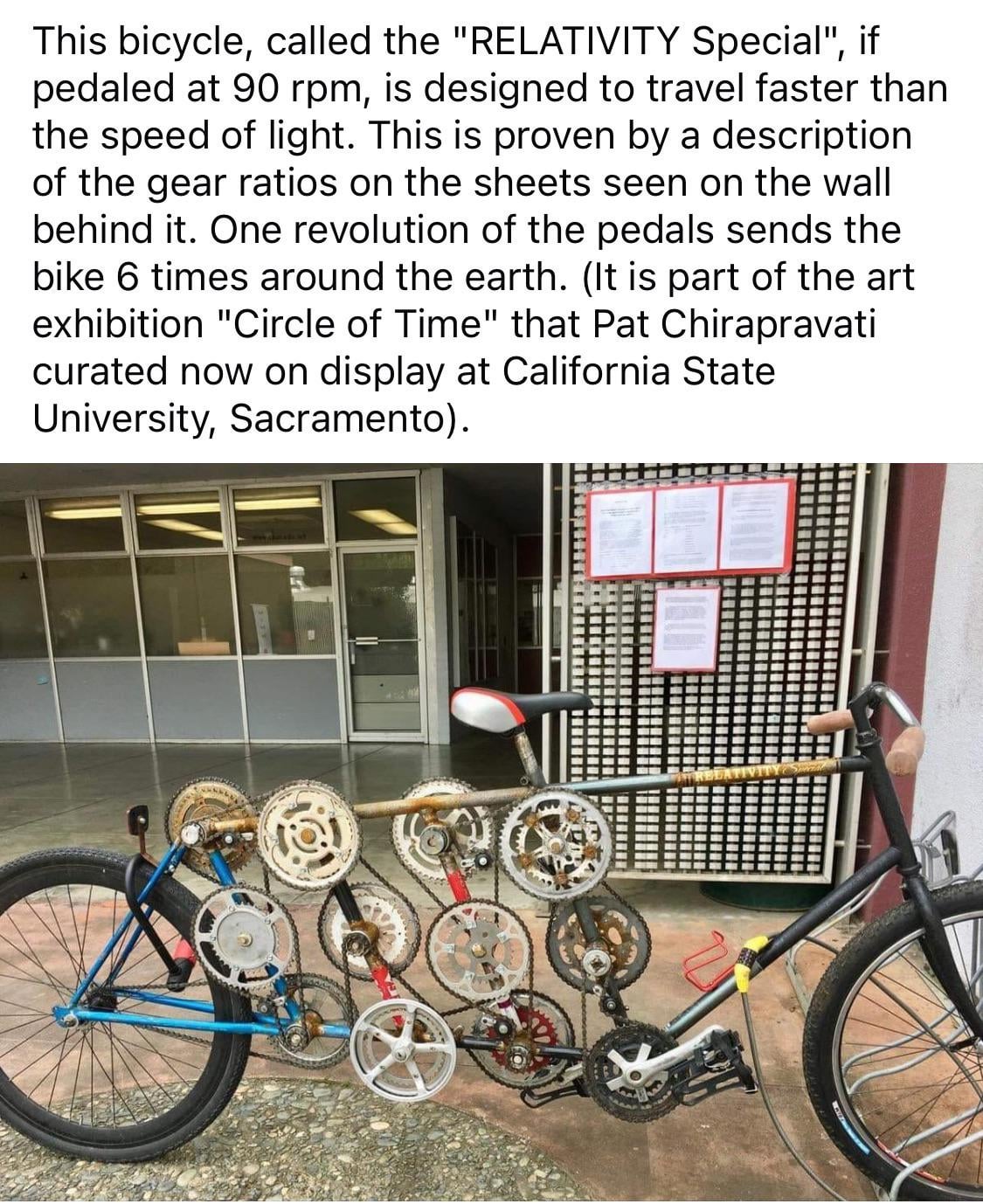
[Request] Assuming you could actually move the pedals and the bike holds together, is this possible?
by DevelopmentWinter627
[Request] Assuming you could actually move the pedals and the bike holds together, is this possible?
by DevelopmentWinter627
22 Comments
If you have infinitely strong legs, and the materials are infinitely strong, and you and the bike don’t burst into flames from friction… you could get very very very close to the speed of light. You can never pass it
My balls hurt just from looking at this.
Not with a lock on the back wheel.
OK, but does it make the Kessel Run in less than 12 parsecs? Asking the real question here!
Assuming the bike wouldn’t disintigrate under the force required to pedal, you’d fling yourself off the earth sooner than you reach light speed. Escape velocity for the Earth is 40,000 km/hr or about 0.0037% the speed of light.
This persons mind will be blown when they see the running motor connected to concrete or steel through a series of gears and it’s predicted to run for years before the motor can no longer turn.
No. Not even close.
It’s like 4^12, maybe? About 16 million gear ratio, maybe? Assuming each is 1:4.
The earth is about 130 million feet around. So you’d have to pedal at least, idk, 10 times to get around the world once. 😆
Can’t travel faster than light speed.
90 rpm wouldn’t be enough. Anyways….
90*16 million is about 1.5 billion.
You’d have to do about 90 rotations per second to ‘exceed’ light speed.
I could probably think of a dozen reasons off the top of my head why this machine wouldn’t work in practice. However, it is art and not engineering. Good art stimulates our imaginations and evokes emotional responses.
I would say that it succeeds at its creator’s goals.
No it would be impossible. There’s a u-lock through the rear wheel.
I’ve been doing lots of hill repeats….I could probably get that bad boy up to speed.
This could be possible, but one would require a very long, straight and smooth rideable surface with gravity and no to build up speed. Those who say one would not exceed the speed of light forget about infinite durability of the bike and rider, and even before the rider and bike would reach that speed, it would happen to balls in bearings and chain links going forward (at least on the last chain), so we could probably see nothing bad ensues to objects when they reach this limit.
we demand and frankly need to see the supporting documentation! someone get a copy of those A4 sheets!
It’s possible in theory, but given its gear ratio you wouldn’t be able to spin the cranks even if the wheels didn’t touch the ground, since the amount of force required to spin the rear wheel would be absolutely impossible to produce.
Can anyone calculate the wattage required to pedal this at 90rpm assume each gearset is ~5:1?
If you saw Oppenheimer, theory will only get you so far.
Damn, imagine all the crazy places I could visit with it.
Reminds me of this but in the opposite sense. https://www.exploratorium.edu/exhibits/machine-with-concrete
After seeing this photo a while back, I tried to do the math:
A 700x45c tire has an circumference of 2.25m and the bike has 12 chains. If each chain drives the same ratio (r) then we have:
𝑟¹²×2.25𝑚×90𝑟𝑝𝑚/60=3×10⁸𝑚/𝑠
solving that gives r=4.596 which is possible with standard bicycle components with road bike ratios like 50:11=4.545 or track bike ratios like 56::12=4.667, but in the picture none of these ratios look quite that big. The cogs don’t look nearly small enough to get the needed ratios, and I suspect this bike would really only get you to 0.01*c.
not even close. even if the target gearing was 1% speed of light (3 million meters a second) you wouldn’t be able to move the pedals. Even if you could generate the force to move the pedals and the chains and everything were strong enough to handle the force, things would melt or explode way before you got even close to 1% speed of light.
He could pull a Starship
This is a demonstration in gear reduction. You can find lots of gear sets that people 3D print that have a crank on one end and the other is embedded in concrete. It takes so many hundreds of millions of RPMs just to get the backlash out of each gearset, that it effectively will never move. The plastic would wear out way before that. This bicycle is the same, but geared the other way. I’d guess the torque required to turn the crank is astronomical, and probably doesn’t actually move because of that.
Typical fixed gear setup