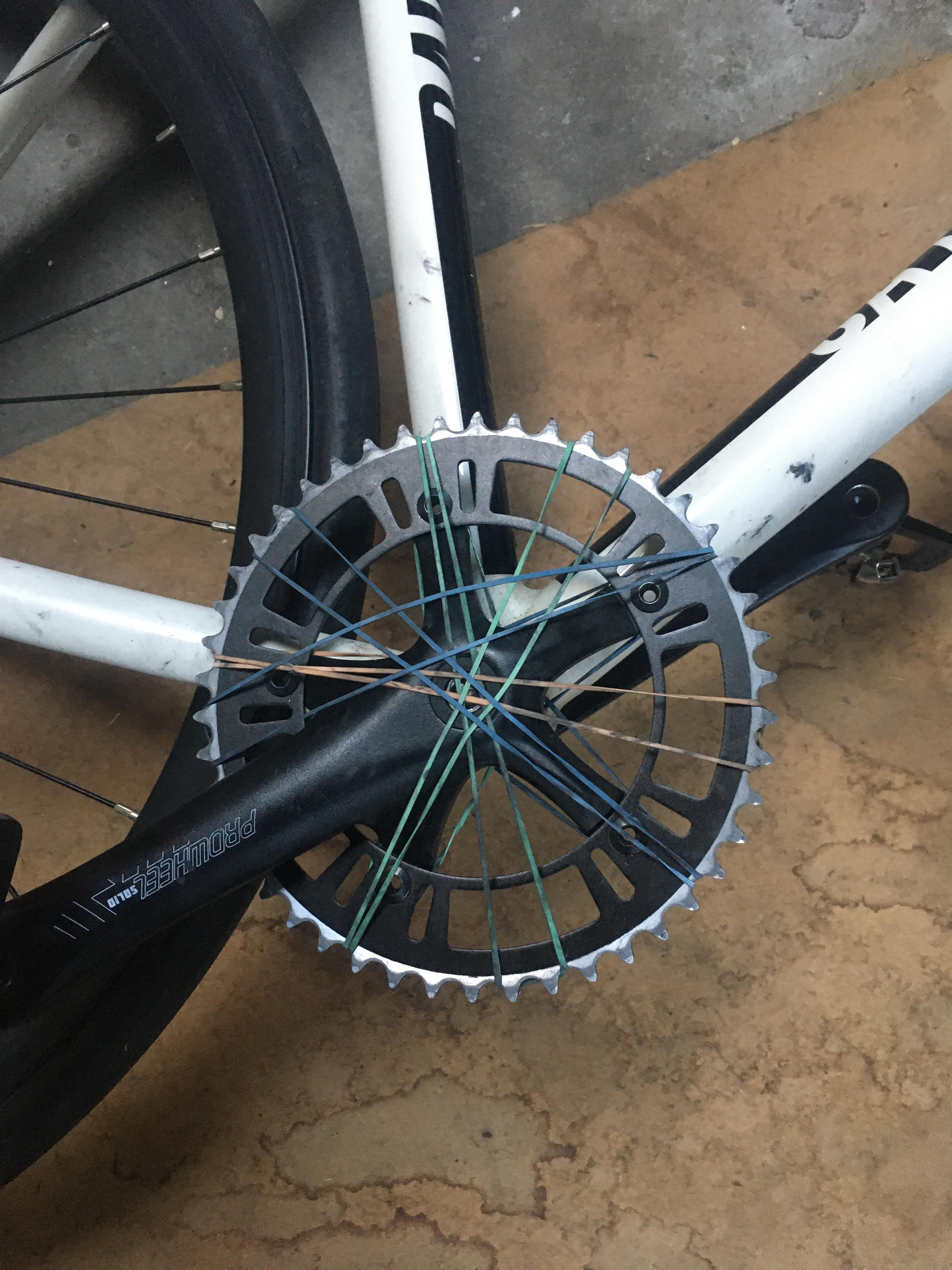
Once you have adjusted the chain slack, you will probably find that it doesn’t remain constant as you turn the crank. The slack varies because the chainring and sprocket aren’t perfectly centered. If you press the wrench down against the middle of the top run of chain while turning the cranks, you can easily see how the amount of slack varies.
It is usually possible to center the chainring. Set the rear axle so that the chain pulls taut at the tightest part of the cranks’ rotation. One at a time, loosen up each of the stack bolts, and tighten it back just finger tight. Turn the crank slowly and watch for the chain to get to its tightest point. Strike the taut chain lightly with a convenient tool to make the chainring move a bit on its spider. Then rotate the crank some more, finding the new tightest spot, and repeat as necessary.
This takes a little bit of your hands’ learning how hard to hit the chain, and how loose to set the stack bolts, but it is really quite easy to learn.
Tighten up the stack bolts a bit and re-check. Tighten them in a regular pattern, like the lug nuts on a car wheel. Our standard pattern is to start by tightening the bolt opposite the crank, then move clockwise 2 bolts (144 degrees), tighten that one, clockwise 2 more, and so on. Never tighten two neighboring bolts in a row (well, not unless there are only 3 or 4 in all — than you have no choice). You may prefer to go counterclockwise, but try to get in the habit of always starting at the same place and always going the same way. This reduces the chances of accidentally missing a bolt.
Once you have the chainrings centered and secured, adjust the position of the rear axle again to make the chain as nearly tight as possible without binding. Notice how freely the drivetrain turns when the chain is too loose. That is how freely it should turn when you are done, but with as little chain droop as possible.
Some rear sprockets are not well-centered either. You may try to center the sprocket using a similar technique, or you may just have to try another sprocket or put up with the problem. This problem is most common with the 3-lug sprockets used on internal-gear hubs and coaster brakes.
Leadfoot31 on
“Center?” I’m curious and new, why does one need to center a chainring that visually looks to have tight tolerances to your crank?
novabrotia on
I loosened the chainring bolts and tightened them finger tight. Then just spun the crank and occasionally squeezed the chain together with my fingers. Worked pretty well
medievalsteak on
Stop thinking about it too much, tighten the bolts in a start pattern
No_Equipment_7618 on
I do it with the chain on. You set the chain tension to how you would ride it except for the tight spot and tighten the wheel down. Then, you loosen all 5 chainring bolts, adjust the chainring position, and retighten the bolts in a star pattern. Now check the chain tension to see if you still have a tight spot. Repeat until the tight spot has been minimized or eliminated.
Tonasino on
I’ve seen that Ali Clarkson in one of his videos rotated disk brake clockwise so that the bolts center the disk. I think that could work here also, taking chainring and rotating it clockwise while the bolts are almost tight, but also loose so it can rotate a bit by hand.
Nightchild666 on
Do people really do this kind of things? Been riding fixed gear for almost twenty years and I’ve never even heard or thought about something like that?

7 Comments
From Sheldon brown:
Centering chainrings
Once you have adjusted the chain slack, you will probably find that it doesn’t remain constant as you turn the crank. The slack varies because the chainring and sprocket aren’t perfectly centered. If you press the wrench down against the middle of the top run of chain while turning the cranks, you can easily see how the amount of slack varies.
It is usually possible to center the chainring. Set the rear axle so that the chain pulls taut at the tightest part of the cranks’ rotation. One at a time, loosen up each of the stack bolts, and tighten it back just finger tight. Turn the crank slowly and watch for the chain to get to its tightest point. Strike the taut chain lightly with a convenient tool to make the chainring move a bit on its spider. Then rotate the crank some more, finding the new tightest spot, and repeat as necessary.
This takes a little bit of your hands’ learning how hard to hit the chain, and how loose to set the stack bolts, but it is really quite easy to learn.
Tighten up the stack bolts a bit and re-check. Tighten them in a regular pattern, like the lug nuts on a car wheel. Our standard pattern is to start by tightening the bolt opposite the crank, then move clockwise 2 bolts (144 degrees), tighten that one, clockwise 2 more, and so on. Never tighten two neighboring bolts in a row (well, not unless there are only 3 or 4 in all — than you have no choice). You may prefer to go counterclockwise, but try to get in the habit of always starting at the same place and always going the same way. This reduces the chances of accidentally missing a bolt.
Once you have the chainrings centered and secured, adjust the position of the rear axle again to make the chain as nearly tight as possible without binding. Notice how freely the drivetrain turns when the chain is too loose. That is how freely it should turn when you are done, but with as little chain droop as possible.
Some rear sprockets are not well-centered either. You may try to center the sprocket using a similar technique, or you may just have to try another sprocket or put up with the problem. This problem is most common with the 3-lug sprockets used on internal-gear hubs and coaster brakes.
“Center?” I’m curious and new, why does one need to center a chainring that visually looks to have tight tolerances to your crank?
I loosened the chainring bolts and tightened them finger tight. Then just spun the crank and occasionally squeezed the chain together with my fingers. Worked pretty well
Stop thinking about it too much, tighten the bolts in a start pattern
I do it with the chain on. You set the chain tension to how you would ride it except for the tight spot and tighten the wheel down. Then, you loosen all 5 chainring bolts, adjust the chainring position, and retighten the bolts in a star pattern. Now check the chain tension to see if you still have a tight spot. Repeat until the tight spot has been minimized or eliminated.
I’ve seen that Ali Clarkson in one of his videos rotated disk brake clockwise so that the bolts center the disk. I think that could work here also, taking chainring and rotating it clockwise while the bolts are almost tight, but also loose so it can rotate a bit by hand.
Do people really do this kind of things? Been riding fixed gear for almost twenty years and I’ve never even heard or thought about something like that?