
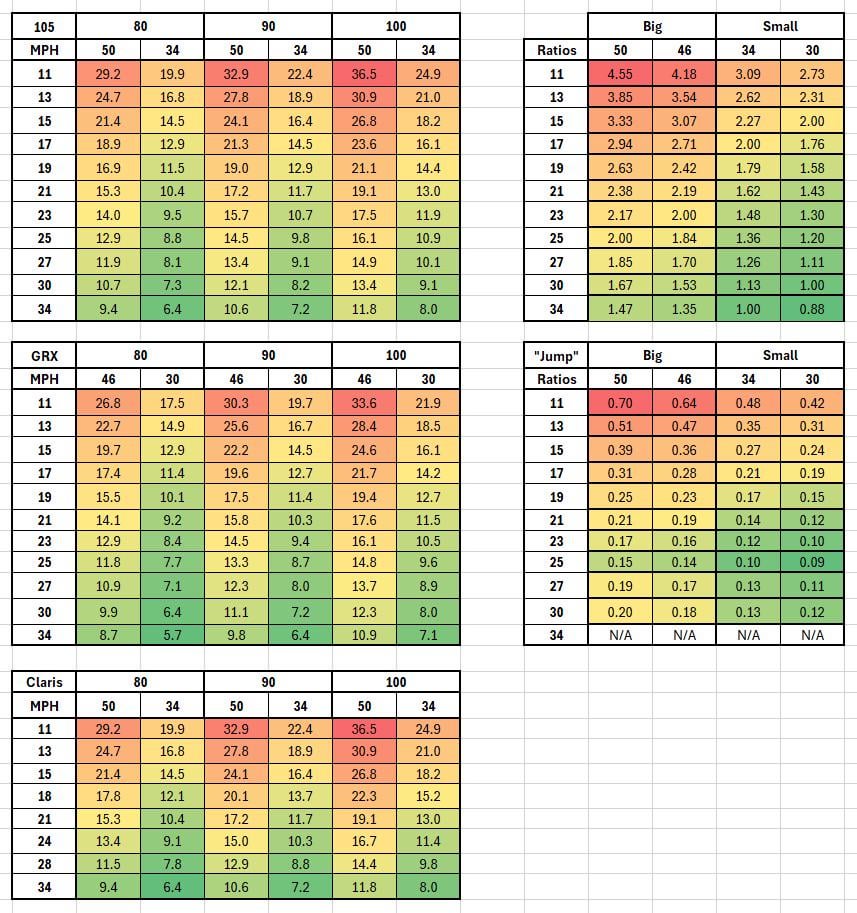
I’m debating between 11-speed bikes, one with a 105 50/34 and the other with GRX 46/30. I keep seeing posts about the 46/30 being harder to keep up, etc than the 50/34 even if same setup otherwise. (Have from a Claris right now)
I’m been reading and comparing using Sheldon Brown’s calculators and put together the comparison in the photo that has MPH with each setup and cadence along with the gear ratios.
I’m not understanding how the 50/34 is harder than the 46/30. I lose the top gear with the 50/34 but gain the bottom with the 46/30. I’m barely ever in 50-11 with my Claris setup, so not concerned there and typically cycle at 17-20mph on the flats. The gear ratios are more gradual with the 46/30, so it’d be easier to stay in a more comfortable cadence based on my understanding.
Am I missing something?
by phillypharm
8 Comments
It’s far simpler – a bigger gear means you have a higher available top speed *if you can spin it*.
If you never need to go faster than what 46/11 provides, then sure – you don’t need 50t or 52t or 53t, etc. Your average casual rider will never need bigger than 46/11. Heck, my commuter uses a 38t ’cause it’s plenty for a commute – but my road bike has a 52t.
Anecdote: My buddy uses a gravel bike with a road wheelset/GP5000 on our group rides. He can’t keep up with us down our long false flat descents – some of these stretch out to several miles and over that distance, 3-5mph difference is a huge gulf to overcome. The rest of us are on 52/11 with him spinning out a 46/11.
Nope, looks like you’ve done the research and based on your riding style and experience the 46/30 is going to be an improvement. A better fit between your available gear ratios and the bike riding you do irl.
another advantage are the smaller jumps between gears at a given speed when using a bigger chainring.
I really wish I understood what I was looking at here.
I like this as a visual tool: [https://gear-calculator.com/?GR=DERS&KB=34,50&RZ=11,13,15,17,19,21,23,25,27,30,34&UF=2170&TF=90&SL=2.6&UN=MPH&DV=speed&GR2=DERS&KB2=30,46&RZ2=11,13,15,17,19,21,23,25,27,30,34&UF2=2170](https://gear-calculator.com/?GR=DERS&KB=34,50&RZ=11,13,15,17,19,21,23,25,27,30,34&UF=2170&TF=90&SL=2.6&UN=MPH&DV=speed&GR2=DERS&KB2=30,46&RZ2=11,13,15,17,19,21,23,25,27,30,34&UF2=2170)
Play with the cadence (how fast you spin the crank)
I can only recommend https://ritzelrechner.de for a more visual and dynamic visualisation and comparison between different drive train setups
https://docs.google.com/spreadsheets/d/16C3Rz6qmzmurSNd-L3IeMSFukkBFV6D1DRbfS59EDrE/edit
This might be useful to you.
You‘re correct, the 46/30 gives you a lower gear and closer gear ratios than the 50/34.
A 30×34 lowest gear is very, very low, you should be able to climb just about any grade you encounter with that gearing, and climb at a very comfortable cadence.
However, even the 50/34 has a 1:1 gear ratio at 34×34, which is also a very low gear, but only you would know which of the two options better suits you. If you’re a strong climber and never climb super-steep grades the 50/34 would probably be sufficient, but if you’re an average climber and you hit steep climbs the 46/30 would be the better choice.
It’s always better to have a low gear you don’t need than to need a low gear you don’t have.