
-
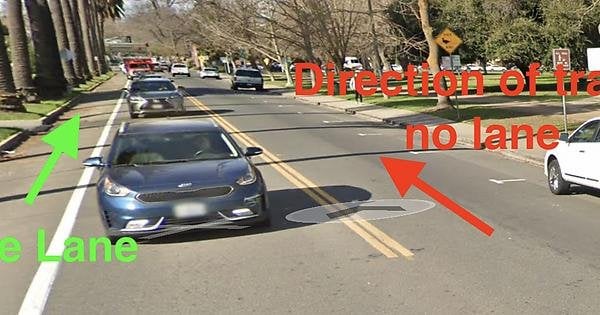
When a street goes from having a bike lane to not having one, but there is a bike land on the opposite side going against traffic. I stopped and waited for a break in traffic. I saw a couple of options I am curious about. Do I Ride over to the other side (which has a bike lane) but be going against traffic. Use the sidewalk (maybe if it was totally clear I might have, but there were people walking). What I am assuming I need to do is just take the lane and hang as far over the right as possible? Here is the street and how it looks, a little further back on my direction of travel, there was a bike lane, that just kind of disappeared
-
When the bike lane is in the far left, since it is a one way street. I had to turn right. I ended up just walking across the crosswalk, but should I have just left the bike lane and moved to the right and signaled that I was turning right as I got closer to my turn? I was a little nervous crossing the road as cars were coming up. Here is the street on google maps, it's changed since. There is only one bike lane, it is on the far left
Thanks for feedback.
by Substantial-Falcon-8
2 Comments
For the first one, I would not cross over to use the bike lane where you would be opposing traffic. There doesn’t appear to be enough room for you to pass a cyclist going in the opposite direction, so too unsafe.
For the second, I don’t have a lot of experience with left-side bike lanes on one-way streets. At a minimum, I would be shifting over to the right lane well before the right-hand turn, and then take the lane until I turned. Initially, I might do as you did, and using the crosswalk, if I was unable to get over sooner. Even after a number of years, I am cautious when thrust into new situations.
The photo helps greatly. Thanks!
With respect to 1: There are no good options here.
Firstly, your own safety is the main factor, not the laws. Yes, read that again! That does not mean to disregard other people’s safety, but to recognize some facts that affect your own:
– Cycling infrastructure is, at best, in transition. Cities add infrastructure _gradually_, and they have to do it while being opposed by vocal, entitled drivers. This means that, at any time, they may be incomplete.
– By and large, cycling laws have not changed much in 50-70 years. They still suffer a 1950s mentality. This results in laws and infrastructure which are unsafe for cyclists–namely, the photo!
What would _I_ do at this spot?
It depends on the context eg day, time, weather, laws. The photo shows dry conditions, high visibility (by/of me, by/of drivers), perhaps no pedestrians. I don’t know the cars’ speed. I see a parked car.
If I am riding on the right (where the white car is) I’d take the sidewalk, unless if there is little car traffic _and_ I am on a fast bike–in which case, I’ll just ride the main lane, like a car. If there is car traffic on that side, I’ll be very careful with that sidewalk, watching for cars that turn right onto them.
My last choice would be the ‘dual’ lane on the left. It has all sorts of dangers, chief among them being the absence of a barrier separating the cars. When I must, I stay as close to the curb as possible, watching for cars turning into traffic, from the sidewalk, or turning into the sidewalk, from the road (which often happens without even turn-signals).
2 is a problem similarly telling of poor infrastrucure.
Again, context matters. At night/rain/dark, and/or with an inexperienced or uncomfortable rider, using/walking the pedestrian crossing would be best. An experienced rider, at day/dry/bright conditions, might switch lanes as s/he rides, depending on the volume and speed of car traffic.
At night, with a non-heavy volume of car traffic moving at a non-fast speed, _I_ might switch lanes _if_ I have a hi-viz vest, a good rear light, and street lighting is sufficient, and I am very familiar with the street (esp. the upcoming intersection), and it is dry, non-freezing conditions with no rainfall that entire evening. But I have decades of experience, in multiple cities.