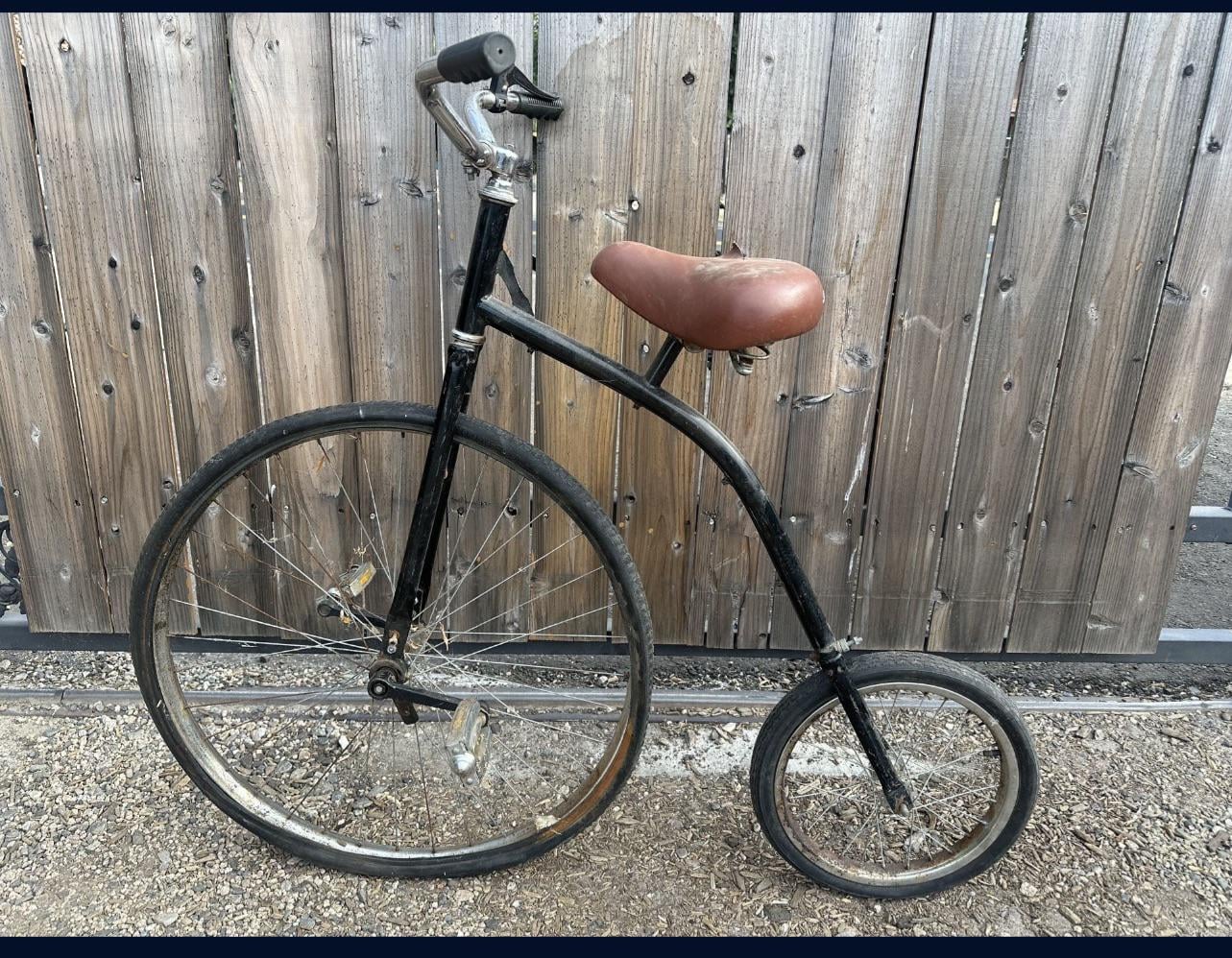
These are really fun to look at. Not the best riders, even those with slightly more modern steering.
How much?
UniWheel on
Only if it’s absurdly cheap.
Direct drive it takes crazy cadence to make good progress – got used to doing distance rides at an average of well over 100 RPM on the unicycle days, and that was with a larger 36″ wheel.
An actual Penny should be in the high-40 to low-50 inch range depending on rider inseam. Sometimes they even went bigger and used pedal blocks to reach!
Also that looks to have so-called “lollipop” bearing holders, which sounded like a good idea, but tend to cause stress risers in the fork tubing and crack it. Modern solutions use two half-clamps to capture the bearings, the upper welded on the the frame – possibly a little harder on the bearings but bearings are cheap and odd frames are expensive.
It might also have “cottered” cranks which are hard to keep tight on the axle
If you want to buy an actual penny or even solid mini-penny they’re made.

2 Comments
These are really fun to look at. Not the best riders, even those with slightly more modern steering.
How much?
Only if it’s absurdly cheap.
Direct drive it takes crazy cadence to make good progress – got used to doing distance rides at an average of well over 100 RPM on the unicycle days, and that was with a larger 36″ wheel.
An actual Penny should be in the high-40 to low-50 inch range depending on rider inseam. Sometimes they even went bigger and used pedal blocks to reach!
Also that looks to have so-called “lollipop” bearing holders, which sounded like a good idea, but tend to cause stress risers in the fork tubing and crack it. Modern solutions use two half-clamps to capture the bearings, the upper welded on the the frame – possibly a little harder on the bearings but bearings are cheap and odd frames are expensive.
It might also have “cottered” cranks which are hard to keep tight on the axle
If you want to buy an actual penny or even solid mini-penny they’re made.