I love planning. But every now and then, I have an experience that makes me think again.
Before I go on a tour, I plan. When I’m on the tour, I revise my plans. And when I get home, I think about how I could plan better. But from my latest trip, I learned that I urgently need to REDUCE my planning.
My change in attitude happened at one very particular point in the world. If you’re interested, I’m going to tell you about it.
———————–
It was in Scotland, but not simply Scotland. The Orkneys, but not just the Orkneys. The island of Rousay, but not just the island of Rousay. It was in Scotland, on Rousay, a few metres off the main road on the north-east corner, on an inauspicious-looking patch of grass and heather. Latitude 59.176. Longitude -3.006.
The corner has a nice view. On that bright midsummer day, I could make out Westray to the north, and Egilsay to the east. And in the sun, the vastness of the North Atlantic stretched out impossibly far into the distance. (I’m a southerner! Where I come from, the solent is a big deal!). But views come, views go. And I wouldn’t insult your intelligence by writing a post about the view.
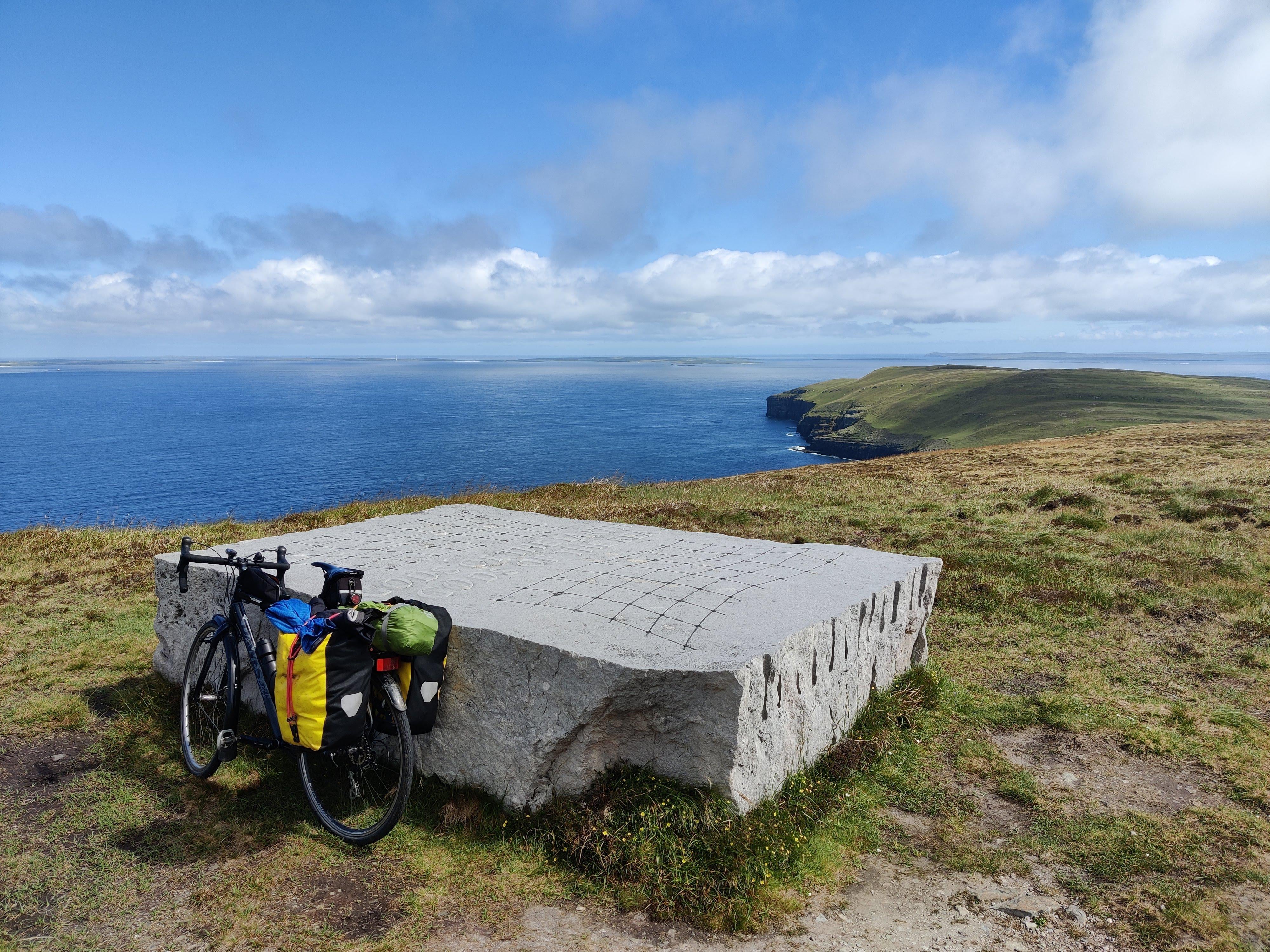
The important thing was, and is, the big chunk of stone dwelling there.
———————–
I saw it from the road. It wasn’t clear what it was. As I got closer, I could see that this wasn’t another random ancient stone (there was clear machine-work around the edges). And as I got closer still, I could see an inscription: Gods of the Earth; Gods of the Sea.
There was no explanation. No notice board. No tourists. Nothing: just the stone making its offering to the universe, and me standing there, in utter awe at the immensity of it all.
I had my suspicions about the stone (what the heck was it there for?). I only found out later that it was a concrete poem by Ian Hamilton Finlay, one of my all time favourites. He wrote lots of little poems about the sea, earth, and air. And he spent some of the most formative years of his life on Rousay, working as a shepherd and labourer in the 1950s.
Rousay was a vital part of his imaginative landscape: and there I was. Taking it all in. Seeing the things he saw, hearing the things he heard, and perhaps even feeling the things he felt. There are very few places in the world that could teach me such things.
———————–
Could I have planned for this? It would have been hard – but not impossible.
The poem isn’t marked on Google at all (even though it’s there on satellite images). I didn’t spot it on the OS maps I consulted ahead of travelling. But Open Street Map – and one Komoot user, the inimitable Matt R, has included a nice photo from his trip to the island. If I’d been really diligent, I might have made sense of the location, and planned to spend more time there.
As it was, I spent less than 24 hours on Rousay. If I’d followed my heart, not my head, I think things would be very different. 2 days? 3 days? A week? I think any of these timescales would have worked for me. So. Sure – I’ll carry on with my planning. But you’d better believe I’m going to leave some more space for myself in the future. The concrete poems deserve it.

1 Comment
I love planning. But every now and then, I have an experience that makes me think again.
Before I go on a tour, I plan. When I’m on the tour, I revise my plans. And when I get home, I think about how I could plan better. But from my latest trip, I learned that I urgently need to REDUCE my planning.
My change in attitude happened at one very particular point in the world. If you’re interested, I’m going to tell you about it.
———————–
It was in Scotland, but not simply Scotland. The Orkneys, but not just the Orkneys. The island of Rousay, but not just the island of Rousay. It was in Scotland, on Rousay, a few metres off the main road on the north-east corner, on an inauspicious-looking patch of grass and heather. Latitude 59.176. Longitude -3.006.
The corner has a nice view. On that bright midsummer day, I could make out Westray to the north, and Egilsay to the east. And in the sun, the vastness of the North Atlantic stretched out impossibly far into the distance. (I’m a southerner! Where I come from, the solent is a big deal!). But views come, views go. And I wouldn’t insult your intelligence by writing a post about the view.
The important thing was, and is, the big chunk of stone dwelling there.
———————–
I saw it from the road. It wasn’t clear what it was. As I got closer, I could see that this wasn’t another random ancient stone (there was clear machine-work around the edges). And as I got closer still, I could see an inscription: Gods of the Earth; Gods of the Sea.
There was no explanation. No notice board. No tourists. Nothing: just the stone making its offering to the universe, and me standing there, in utter awe at the immensity of it all.
I had my suspicions about the stone (what the heck was it there for?). I only found out later that it was a concrete poem by Ian Hamilton Finlay, one of my all time favourites. He wrote lots of little poems about the sea, earth, and air. And he spent some of the most formative years of his life on Rousay, working as a shepherd and labourer in the 1950s.
Rousay was a vital part of his imaginative landscape: and there I was. Taking it all in. Seeing the things he saw, hearing the things he heard, and perhaps even feeling the things he felt. There are very few places in the world that could teach me such things.
———————–
Could I have planned for this? It would have been hard – but not impossible.
The poem isn’t marked on Google at all (even though it’s there on satellite images). I didn’t spot it on the OS maps I consulted ahead of travelling. But Open Street Map – and one Komoot user, the inimitable Matt R, has included a nice photo from his trip to the island. If I’d been really diligent, I might have made sense of the location, and planned to spend more time there.
As it was, I spent less than 24 hours on Rousay. If I’d followed my heart, not my head, I think things would be very different. 2 days? 3 days? A week? I think any of these timescales would have worked for me. So. Sure – I’ll carry on with my planning. But you’d better believe I’m going to leave some more space for myself in the future. The concrete poems deserve it.