
Health benefits of pedestrian and cyclist commuting: evidence from the Scottish Longitudinal Study | Active commuters were less likely to suffer from a range of negative physical and mental health outcomes than non-active commuters
by Hrmbee
Health benefits of pedestrian and cyclist commuting: evidence from the Scottish Longitudinal Study | Active commuters were less likely to suffer from a range of negative physical and mental health outcomes than non-active commuters
by Hrmbee
1 Comment
From the overall findings:
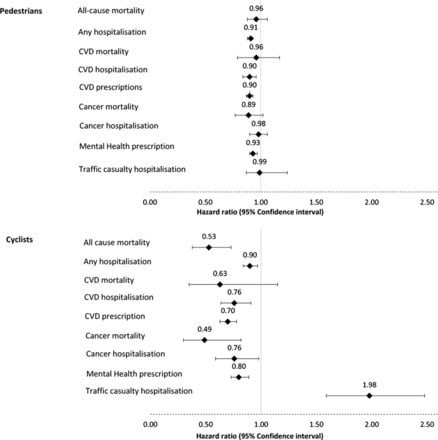
>This is the first study to provide direct evidence of the association between active and non-active commuting and health outcomes over a long period for Scotland. The study identified clear and consistently lower risks of adverse health outcomes among active commuters, especially cyclists. Compared with non-active commuters, cyclists had 47% lower risk of death from any cause, 10% lower risk of any hospitalisation, 24% lower risk of CVD hospitalisation and 30% lower risk of receiving a CVD related prescription, 24% lower risk of cancer hospitalisation and 51% lower risk of cancer death, and a 20% lower risk of receiving a mental health related prescription. Pedestrian commuters, compared with non-active commuters, had a 9% lower risk of any hospitalisation, 10% lower risk of CVD hospitalisation or of receiving a CVD related prescription, and 7% lower risk of receiving a mental health related prescription. However, cycle commuters were twice as likely as non-active commuters to be hospitalised due to a traffic collision.
It’s good to see that there’s some quantifiable health benefits to active commuting, particularly by bike, though the final point that hospitalisation due to collision is twice as high for us is pretty grim. If there’s an action point to be taken from this, it’s perhaps that we need to be pushing local politicians harder to create safe and complete infrastructure to support active transportation.