My use case is running them in 55-559 / 26×2.20 sizes on a steel frame gravel bike with 80kg total mass with no suspension at about 3 Bar with TPU tubes mainly on mediocre smooth asphalt.
My goal is lowest rolling resistance possible while maintaining some comfort/grip/puncture resistance.
(Silca Pressure calculator recommends running them even lower pressure at about 1.8 Bar, which seems ridiculously low to me even factoring in bump hysteresis ( [https://silca.cc/pages/pro-tire-pressure-calculator](https://silca.cc/pages/pro-tire-pressure-calculator) )
Tire casing matters more than almost anything else. It’s why Gatorskins are slower than putting literal molasses around your rims. But also, these have better rolling resistance in this testing environment. That doesn’t quite translate into real world performance, which is going to vary based on surface and other factors.
bob25997 on
I have no engineering back ground or know anything about this but is it contact area size. Also does the tire weigh have an effect.
dirthurts on
It’s all about friction. The knobby tires have so little contact with the ground, there is very little friction to slow you down. They may look grippy, but they’re actually not. The slicks have constant contact with the ground, and thus constant friction. Think brake pads against the rotors. The more contact you get, the more friction, the better stopping power.
The slicks will feel smoother and faster, but in reality you’re losing a lot of energy to heat and friction, just not much to vibration.
Now, just because a tire is faster, doesn’t mean you’ll ride them faster. That’s an entirely different concept.
whewtang on
It’s because the bicycle rolling resistance site should be ignored.
tank19 on
I think that you lose some in the comparison because those tires aren’t in the same class. You are comparing an xc tire that is probably 2in with a 28mm road tire at the same psi. If I have 45psi in a similar mtb tire it is usually rock solid. 45psi in a similar road tire is super deflated and not ideal. Lots of deformation causing resistance. My wild guess number based on my experience would make 30psi on the mtb equivalent to 100psi on the road tire.
Skuggsja on
The site solely tests hysteresis (deformation) and disregards suspension losses (impedance). This means that they always «prove» that rolling resistance goes down as pressure goes up. I suspect a bare rim with no tire would win this test protocol easily.
With these two particular tires it might be that the knobby one has superior casing (real effect), or that the knobs resist deformation to a larger degree than slick tread (effect created by test protocol).

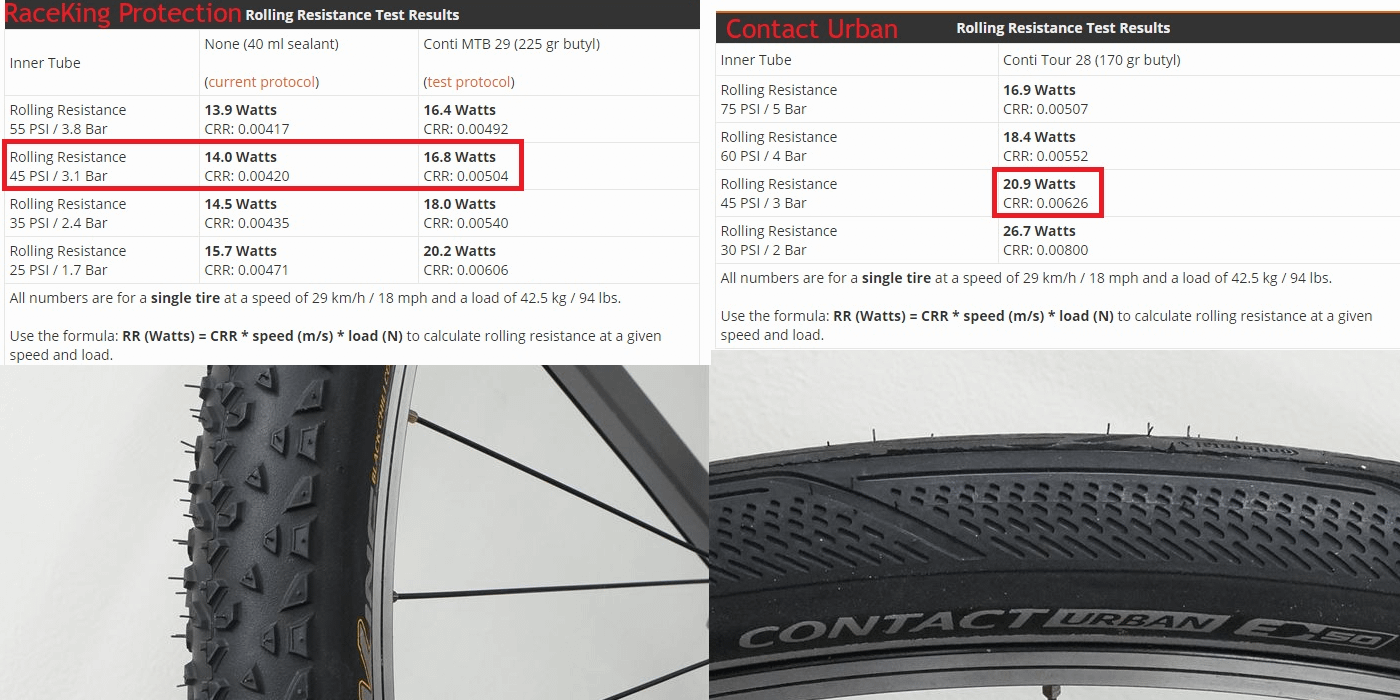
7 Comments
This question has bugged me for a while and i haven’t seen a clear answer besides dogmatic slick=faster answers.
Generally speaking is it possible for knobby tires to roll faster than slicks due to superior compound etc?
How realistic are these results in the real world? (more about test methology: [https://www.bicyclerollingresistance.com/the-test](https://www.bicyclerollingresistance.com/the-test) )
My use case is running them in 55-559 / 26×2.20 sizes on a steel frame gravel bike with 80kg total mass with no suspension at about 3 Bar with TPU tubes mainly on mediocre smooth asphalt.
My goal is lowest rolling resistance possible while maintaining some comfort/grip/puncture resistance.
(Silca Pressure calculator recommends running them even lower pressure at about 1.8 Bar, which seems ridiculously low to me even factoring in bump hysteresis ( [https://silca.cc/pages/pro-tire-pressure-calculator](https://silca.cc/pages/pro-tire-pressure-calculator) )
These are my Favorites so far
[https://www.bicyclerollingresistance.com/mtb-reviews/continental-race-king-protection-2020](https://www.bicyclerollingresistance.com/mtb-reviews/continental-race-king-protection-2020)
[https://www.bicyclerollingresistance.com/tour-reviews/continental-contact-urban](https://www.bicyclerollingresistance.com/tour-reviews/continental-contact-urban)
Many thanks for your Input!
Tire casing matters more than almost anything else. It’s why Gatorskins are slower than putting literal molasses around your rims. But also, these have better rolling resistance in this testing environment. That doesn’t quite translate into real world performance, which is going to vary based on surface and other factors.
I have no engineering back ground or know anything about this but is it contact area size. Also does the tire weigh have an effect.
It’s all about friction. The knobby tires have so little contact with the ground, there is very little friction to slow you down. They may look grippy, but they’re actually not. The slicks have constant contact with the ground, and thus constant friction. Think brake pads against the rotors. The more contact you get, the more friction, the better stopping power.
The slicks will feel smoother and faster, but in reality you’re losing a lot of energy to heat and friction, just not much to vibration.
Now, just because a tire is faster, doesn’t mean you’ll ride them faster. That’s an entirely different concept.
It’s because the bicycle rolling resistance site should be ignored.
I think that you lose some in the comparison because those tires aren’t in the same class. You are comparing an xc tire that is probably 2in with a 28mm road tire at the same psi. If I have 45psi in a similar mtb tire it is usually rock solid. 45psi in a similar road tire is super deflated and not ideal. Lots of deformation causing resistance. My wild guess number based on my experience would make 30psi on the mtb equivalent to 100psi on the road tire.
The site solely tests hysteresis (deformation) and disregards suspension losses (impedance). This means that they always «prove» that rolling resistance goes down as pressure goes up. I suspect a bare rim with no tire would win this test protocol easily.
With these two particular tires it might be that the knobby one has superior casing (real effect), or that the knobs resist deformation to a larger degree than slick tread (effect created by test protocol).