
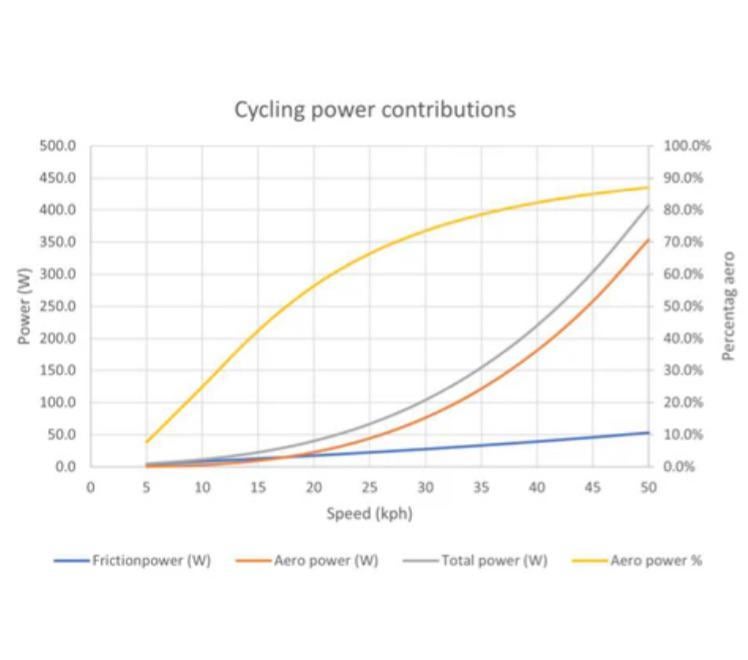
I’ve been thinking about this graph and the fact (so I’m told!) that wind resistance is exponential. Wouldn’t this mean that the energy per distance traveled would be significantly less at slower speeds? For example traveling at 15 kph for 2 hours will take less than half the energy as traveling at 30 kph for 1 hour. I guess there are “time on the bike” fatigue factors as well… but is this correct??? And if so why does no one talk about it?
by Ok-Birthday1258
9 Comments
>Wouldn’t this mean that the energy per distance traveled would be significantly less at slower speeds?
Yes. At a speed of zero, you will use zero energy, but you will never arrive at your destination.
At some point you need to consider the time cost of travelling slower.
It’s because aero resistance is caused by the frontal surface area. It also means that small aero gains (eg position) have bigger benefits at higher speeds
I ride a flat bar road bike and I can feel this graph. Over 30kph on the flat becomes really hard work.
There are a few things to consider when talking about efficiency.
Yes air drag increases dramatically with increasing speed due to the poor aerodynamics of normal upright bicycles.
It is also true that going slow deliberately will reduce the amount of energy you use.
However, if you ride for any appreciable time you will know that attempting to reduce the speed you ride at is not actually that easy. Once you have a level of fitness you will tend to ride in a preferred cadence while also putting out fairly even power. For example with the gearing I have on my bike that tends to be about 27-30 km p/h.
Even when I did some touring and was doing 80-100+ km per day, one thing I noticed was that you tend to maintain a fairly constant cadence. Speed will obviously be affected by wind, gradient and fatigue, but generally you will be fairly constant with your cadence.
So I guess from a purely energy needed to go X amount of distance a slower speed might be better, but it is hard to deliberately ride slow for a lot of people.
Correct, the equation for aerodynamic drag is:
1/2 Cd(a) ρ V² S
Where:
Cd(a) = the coefficient of aerodynamic drag.
ρ = Greek letter rho (pronounced “row”). Air density.
V = velocity.
S = Area / size.
So if you double the speed, the drag quadruples.
Triple the speed and drag goes up by a factor of 9.
Your assumption is that people are looking to minimize power per distance.
That sounds like commuter thinking.
Yes. If you go slower, you’ll spend less energy (KJ) per distance unit.
This IS actually something touring and ultra distance cyclists know: they want to cover big distances per day, so it’s more efficient for them to ride slower and minimize time OFF the bike to maximize time ON the bike, than to ride faster.*
That’s why Lael Wilcox eats fries from her top tube bag while riding: [https://www.youtube.com/watch?v=AEEGIt6FC34&t=131s](https://www.youtube.com/watch?v=AEEGIt6FC34&t=131s)
*of course you want all the ‘free speed’ you can get (aero, weight and rolling resistance optimization), but pedaling harder is always a bad deal. Even more so because it doesn’t just cost more KJ per distance unit, but also requires a larger % of those KJ to come from carbohydrate metabolism.
The hard part about riding slow is that it takes longer to get there. By the time you add your body’s basic calorie and water consumption needs, time in the heat and sun, yea sometimes it can feel easier to just smash it out quickly with a couple bottles and a banana in your pocket rather than cruising and stopping to eat, pee, coffee, take pictures, etc etc.
I think people who ride much just know this from experience. Given any distance I want to ride I’ll do it at the generally highest effort I can comfortably (sometimes uncomfortably) maintain to finish at the highest average speed. It’s a balance of the aerobic effort and the effort of just sitting on the bike in a good position which is wearing in and of itself. For 30 or 40 miles I’ll work sort of hard. Rides over 60 miles is where I go into my “maximum minimum effort”. I should trademark that. It’s an effort I can maintain for a longish time, but any less effort doesn’t increase my ability to keep going, it just slows me down an causes me to spend more time on the bike and be uncomfortable for longer.