
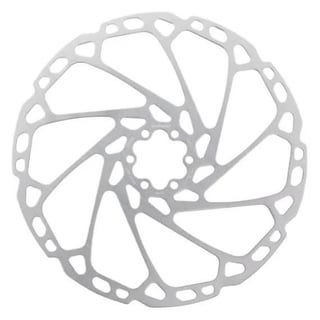

if you look at the attached photos, you'll see the Shimano Sm-Rt66, a very cheap rotor, and a SRAM HS2, a very expensive rotor. (7x the cost of the Shimano in NZ)
why is it that the Shimano appears to be 75% air and only 25% area for the pad to contact? I'd have genuine concerns about stopping power/heat control. being that these are stamped they aren't saving any material, is this designed enshittification to get you to buy a more expensive rotor with 'more material'?
then you look at the SRAM, it's very round, and has much smaller more consistent cooling vents across it. looking more like 80% contact area and 20% vents.
will you actually see a poorer performance from the Shimano due to the small amount of actual contact area? or will they function similarly and I'm just overthinking it?
by MEE97B
10 Comments
they done the math (hopefully)
The braking power needed is not like a car. I expect there is more fear of the calipers grabbing the disc to hard and flipping the bike.
It is all in the engineering, everything is a give and take. Shimano now uses thin pads, the height of Shimano pads are shorter than the industry “standard” pads but are now longer. So it more or less evens themselves out. Also rotor thickness is now a factor, gone are the days of 1.8mm rotors being standard.
You are also comparing a basic Shimano rotor to a more premium Sram rotor with an aluminum core (the black part).
Why would they not be saving material if they are stamped? The off cuts can be added to the next lot of material going into the furnace and be remelted for the next batch.
The ones you mention are for two different types of riders/riding.
The SRAM SH2 is for enduro and eMTBs.
The Shimano SM-RT66 is for XC and trail.
Maybe the first one is more optimized for lighter weight/cooling, and the second one is more optimized for stopping power?
Either you prioritise weight and looks or brake surface and heat dissipation. You might be rolling on the flat or falling down hills also. Bite can be achieved on both setups.
Weight reduction.
You are correct that a heavier rotor will be able to absorb a bit more heat, but if you don’t need that extra heat buffer, then it’s just unnecessary weight you’re carrying around.
The Shimano RT66 is a road bike rotor. Weight matters, supposedly. If you have a heat dissipation problem on a road bike, it’s because you’re descending mountains or something, and a heavier rotor isn’t going to solve your problem. It will just melt a few seconds later.
The SRAM HS2 is a MTB rotor. Your brakes are on-off, on-off, even for downhill. Your rotor gets many opportunities to cool, and in that case, a heavier rotor *will* make a bigger difference.
I don’t think you’ll really notice too much of a performace difference unless you are on gravel going down a mountain. I have both, the cheapest Shimano pictured and the higher cost Shimano RT-CL800 and really haven’t noticed a difference. I’ve tried the cheaper one on a MTB ride with my gravel bike and it held up going down a mountain, I did had some of the more expensive Shimano resin pads with wings.
Both work fine but are designed for different strengths in this case lightweight duty (cross country) vs heavyweight (downhill)